
Your cart is currently empty!
A Sacred Exegesis & Historical Deep Dive: Into The Battle Cry of the Kingdom and the Paradox of the Cross
I. An Open Letter of Love & Invitation to the Student
My Beloved Child of God, My Dear Fellow Traveler on the Royal Road of the Cross,
I write these words to you today with a heart overflowing with the burning love of Jesus Christ and the tender, fatherly affection of the Holy Spirit. As I bow my knees before the God and Father of our Lord Jesus Christ, my soul aches with a holy longing: that you would not merely coast along the shallows of modern religious routine, but that you would be caught up into the blazing, unquenchable fire of His eternal Word.
We live in an hour when the divine summons of our King has too often been muted; reduced to a quiet, painless transaction, a cheapened “ticket to heaven” that asks nothing of your heart, demands no surrender of your will, and strips the Gospel of its ancient majesty and military glory. But my heart cries out for you! I desire to see you ignited with apostolic passion, standing firm in the divine enlistment to which you were called before the foundation of the world.
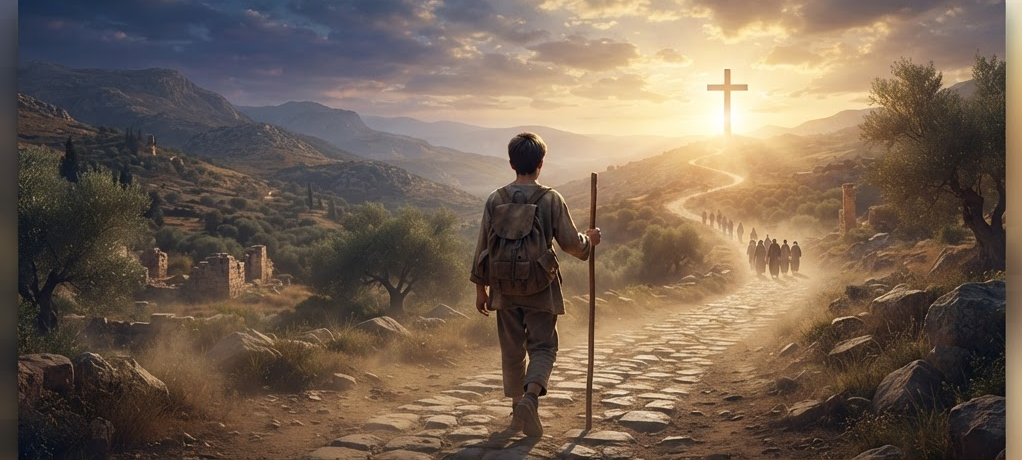
When Jesus turned to the vast multitudes following Him in Luke 14, He did not smooth over the edges of truth to keep the crowds entertained. He paused, looked deep into their eyes with burning love and uncompromising authority, and blew a shofar blast that shattered all religious illusion. He called them and He calls you today; not to a life of passive ease, but to an absolute surrender, a divine enlistment, a daily march behind the Captain of our Salvation.
Open your heart, my beloved student. Lean in with spiritual hunger. Let us step together back across two millennia into the dusty roads of Judaea, into the echoes of Qumran, into the scrolls of the prophets, and into the rich, golden tapestry of the Greek and Hebrew scriptures. May the Holy Spirit quicken your mind, warm your heart, and set your spirit ablaze with a passion to count the cost, take up your cross, and follow Him to the ends of the earth!

II. The Historical & Heavenly Horizon: Vivid Setting of the Scene
To grasp the explosive weight of Messiah’s command, we must first immerse our senses in the atmosphere of 1st-century Roman Judaea.
Picture yourself standing in the crowded, sun-drenched streets of Jerusalem during a pilgrimage feast. The air is thick with the scent of roasted grain, woodsmoke, incense, and the blood of sacrifices from the Temple mount. The chatter of Aramaic, Greek, Hebrew, and Latin echoes off the stone walls of the city. Yet, beneath the vibrant religious fervor lies a suffocating, terrifying shadow: the oppressive heel of Imperial Rome.
Look toward the northwest corner of the Temple Mount. There looms the imposing dark stone structure of the Fortress Antonia, its four towering turrets gazing down upon the Jewish worshipers. Roman legionaries, clad in gleaming iron segmented armor (lorica segmentata), holding heavy scuta shields and crested helmets, patrol the ramparts. Their iron-studded war boots (caligae) clatter rhythmically against the stone paving. Rome ruled Judaea not by soft diplomacy, but through absolute, bloody, unyielding terror.
And what was Rome’s ultimate instrument of terror? It was the Cross (Stauros in Greek; Crux in Latin).
THE ROMAN INSTRUMENT OF TERROR:THE PATIBULUM AND THE CRUCIFIXION MARCH
[Roman Fortress Antonia] > [ Iron Legionaries Escort ]
[Condemned Criminal Carrying Patibulum] Naked, scoured, stripped of all legal rights Walking public streets of Judaea. Point of No Return: Physical & Social Erasure[ The Execution Site ]
To 1st-century ears, the word “cross” was not a piece of polished gold jewelry hanging from a chain around someone’s neck. It was a word so horrifying, so visceral, that refined Roman citizens like Cicero declared it should never even pass through the lips or thoughts of a decent man (“Far be the very name of a cross not only from the body of Roman citizens, but even from their thoughts, their eyes, their ears”).
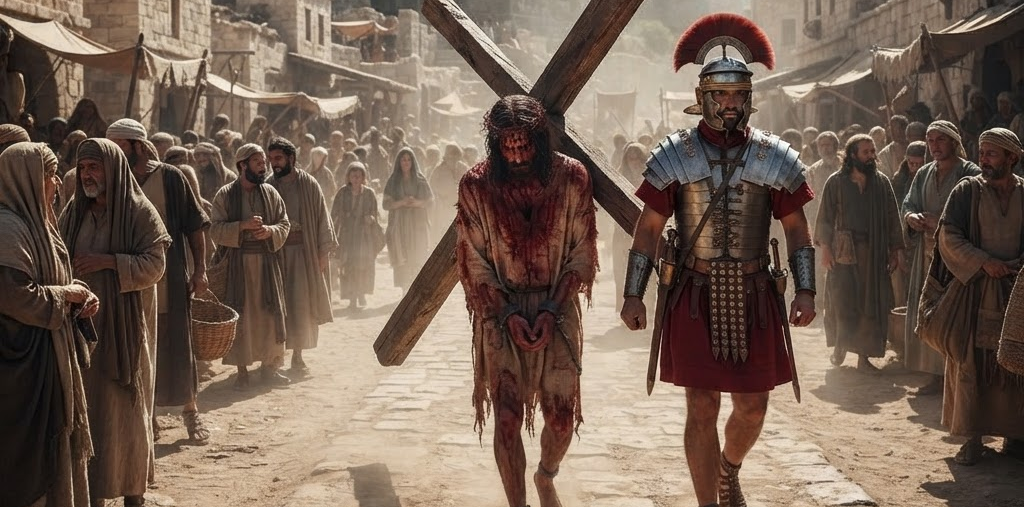
When the Roman governor condemned a rebel, a insurgent (lestes), or a runaway slave to death, the prisoner was publicly stripped, scoured with the bone-studded leather flagellum, and forced to carry the heavy transverse crossbeam; the patibulum; weighing sixty to one hundred pounds, across his own bloody, shredded shoulders through the center of the town.
Think of what the ancient onlookers saw when a condemned man walked through the market square carrying that beam!
- They saw a man whose legal rights were utterly canceled.
- They saw a man whose social standing was completely erased.
- They saw a man walking a one-way street. He was not coming back to his home, his trade, his family, or his ambition. The moment his hands were bound to that beam, he was a living corpse, acknowledging that Imperial Rome was master and his own ego was dead.
Now, imagine the scene when Messiah Jesus turned to the enthusiastic crowds following Him; crowds who were dreaming of a earthly political messiah who would instantly drive out the Romans, restore national glory, and hand them soft thrones of privilege. Jesus turns, His eyes piercing through their romantic fantasies, and proclaims:
“And whoever does not bear his cross and come after Me cannot be My disciple.” (Luke 14:27)
It was as though a bucket of icy water had been thrown over the fire of their carnal expectations! Jesus was declaring: “If you wish to walk with Me, you are not marching to a political coronation; you are marching to an execution of the self. You are enlisting in a heavenly war where self-ownership dies so that the divine life may reign.”
Simultaneously, we must look further back into the heavenly horizon to the wilderness of Sinai. There, under the burning desert sky, God pulled Israel out of Egypt’s bondage not to live as undisciplined, self-indulgent nomads, but to form a holy war-host (Tzva’ot). The tents were pitched in precise military order around the Tabernacle; the silver trumpets sounded military alarms; the Ark of the Covenant led the march. Yet, when they reached the border of Canaan at Kadesh-barnea, a tragic spiritual paralysis gripped the hearts of the people. They saw the towering, fortified walls and the giant clan of the Anakim, and they shrank back in unbelief. They desired the bread of redemption without the battle of consecration. That wilderness horizon stands as a perpetual warning across ancient history: Redemption out of Egypt is an invitation to enlist, not a license to sink into spiritual sloth.
III. Ancient Textual Context & Manuscript Deep-Dive
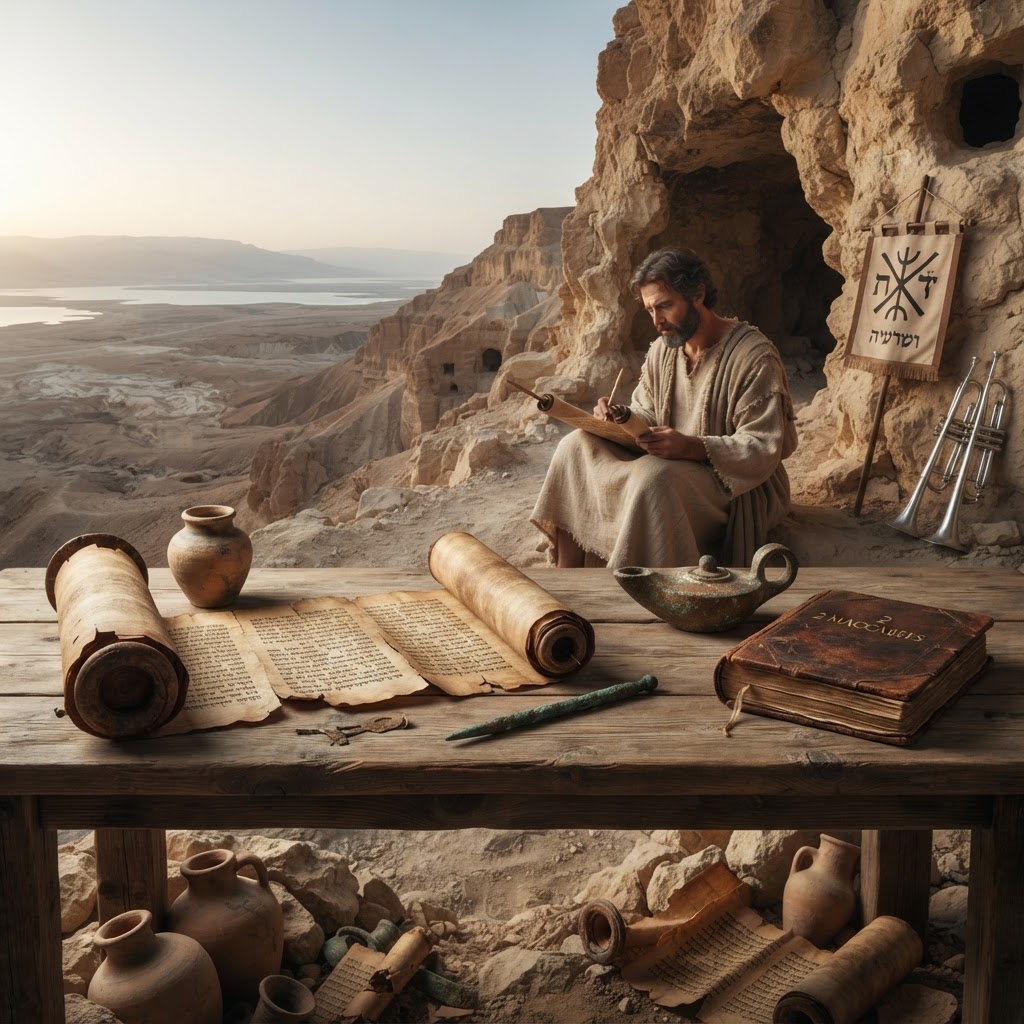
To fully illuminate the biblical background of counting the cost, spiritual enlistment, and the warnings against wilderness apostasy, we must examine the extra-biblical ancient Jewish literature, the Dead Sea Scrolls (Qumran manuscripts), Second Temple historical accounts, and Rabbinic Targums. These ancient texts reflect the worldview of the 1st-century biblical audience and provide profound historical clarity.
ANCIENT TEXTUAL LANDSCAPE & EXTRA-BIBLICAL SOURCES
1QM(War Scroll) > Qumran rules of Holy War, counting cost, strict purity
1QS(Community Rule)> Total surrender of wealth, self-denial, covenant oath
2 Maccabees 7 > Martyrs who counted the cost unto death over compromise
Targum Pseudo; Jonathan > Expansions on Israel’s wilderness battle formation
Enochic Literature > Cosmic background of Canaan’s giants (Spiritual War)
1. The Dead Sea Scrolls: Military Enlistment & The War Scroll (1QM)
Discovered in the caves of Qumran overlooking the desolate shores of the Salt Sea, the Dead Sea Scrolls provide an extraordinary window into the mindset of Jewish believers living around the time of Jesus who withdrew to the desert to prepare for the final spiritual war.
In the famous War Scroll (1QM – Milhamah), the Qumran community described the apocalyptic battle between the “Sons of Light” (Benei Or) and the “Sons of Darkness” (Benei Hoshek). What is striking in 1QM is the absolute requirement of total preparation, strict discipline, and exhaustive counting of the cost before enlisting in God’s army:
Exclusion of the Unfit: In 1QM 7:3-7, anyone who was timid, fearful, faint-hearted, or morally double-minded was strictly forbidden from entering the battle ranks, drawing directly upon the military laws of Deuteronomy 20:8.
The Silver Trumpets: The scrolls describe silver trumpets blown by the priests, inscribed with phrases like “The Called of God” (Kru’ei El) and “The Assembly of War” (Adat Milhamah).
The Banners (Otot): Before going to battle, banners were unrolled inscribed with mottoes such as “The Truth of God” (Emet El) and “The Recompense of God” (Gmul El).
In 1QS (The Community Rule / Serek ha-Yahad), when a candidate desired to join the covenant community, they underwent a rigorous multi-year examination period. They had to “count the cost” by handing over all their material wealth into the common treasury (1QS 6:18-23), swearing a solemn oath to separate from all wickedness, to embrace self-denial, and to walk in complete obedience to the Commander’s statutes.
This ancient practice illuminates Jesus’ statement in Luke 14:33: “So likewise, whoever of you does not forsake all that he has cannot be My disciple.” The concept of abandoning personal wealth and worldly security to enter a holy covenant community of warfare was deeply rooted in the Second Temple spiritual worldview!
2. Second Temple Literature & Martyrdom: 1 & 2 Maccabees
In the era between the Old and New Testaments, under the bloody persecution of the Seleucid tyrant Antiochus IV Epiphanes (167 BC), Jewish believers were forced to decide whether to cling to their earthly lives through compromise or to “count the cost” and die for the covenant of God.
In 2 Maccabees 7, we read the harrowing account of the mother and her seven sons. One by one, the sons were tortured, scalped, and burned alive before their mother’s eyes because they refused to eat swine’s flesh or violate the Law of Moses. The youngest son, addressed by his heroic mother, was exhorted:
“Do not fear this executioner but prove yourself worthy of your brothers and accept death, so that by God’s mercy I may receive you again with your brothers.” (2 Maccabees 7:29)
These martyrs understood psēphizō tēn dapanēn; they had calculated the total outlay of human life, weighed temporary pain against eternal glory, and freely yielded their earthly existence. When Jesus spoke of taking up the cross, His audience was intimately familiar with the heroic memory of the Maccabean martyrs who had chosen public execution over spiritual betrayal.
3. Targumic Expansions & Midrashic Background on the Wilderness Generation
To understand the warnings in 1 Corinthians 10:1–12 and Hebrews 10 regarding the wilderness generation, we must examine how early Jewish tradition viewed Israel’s exodus and desert testing.
In Targum Pseudo-Jonathan on Exodus 13:18, the Hebrew word chamushim (translated in KJV as “armed”) is expanded to describe Israel departing Egypt in a five-fold military battle order (mukhmeshin; fortified and arrayed as five battle divisions). They did not exit Egypt as a disorganized rabble; God brought them out as a structured army ready for battle!
Furthermore, in Midrash Rabbah on Numbers (Bamidbar Rabbah 16:11), ancient Jewish scholars wrestled with why the generation of the Exodus perished in the desert despite beholding the ten plagues, the splitting of the Red Sea, and the daily manna. The Midrash reveals that the heart of their sin was contempt for the battle of faith. When the ten spied scouts brought back an evil report regarding the giants (Anakim), the people wept and cried: “Let us make a captain and let us return into Egypt” (Numbers 14:4).
The Rabbinic commentators noted: “They wanted the redemption of Egypt without the sacrifice of Canaan.” They loved the physical gifts of God (fish, cucumbers, melons of Egypt), but loathed the spiritual warfare and consecration required to possess the Promised Land. This directly aligns with the Apostle Paul’s warning in 1 Corinthians 10:5: “But with many of them God was not well pleased: for they were overthrown in the wilderness.”
IV. Sacred Language & Linguistic Gems
The Holy Spirit selected the precise vocabulary of the Greek New Testament and the Hebrew Tanakh (and its Greek translation, the Septuagint / LXX) to communicate the absolute cost of discipleship and spiritual combat. Let us unearth these linguistic treasures.
LINGUISTIC GEM MATRIX & ROOT ANALYSIS
GREEK / HEBREW TERM
ETYMOLOGICAL ROOT MILITARY & WARFARE CONCEPT
Psēphizō ψηφίζω)
Psēphos (a worn stone) Meticulous calculation/voting
Dapanē (δαπάνη)
Dapto (to devour/consume) Exhaustive expenditure/cost
Stauros (σταυρός)
Histēmi (to stand upright) Execution post; total death
Akolouthei (ἀκολουθεί) A- (together) +
Keleuthos Marching in strict military (a path)tactical formation
Panoplia (πανοπλία)Pas (all) + Hoplon (weapon)Full heavy infantry armor
Katapausis (κατάπαυσις)Kata (down) + Pauō (cease)Cessation of war in Victory
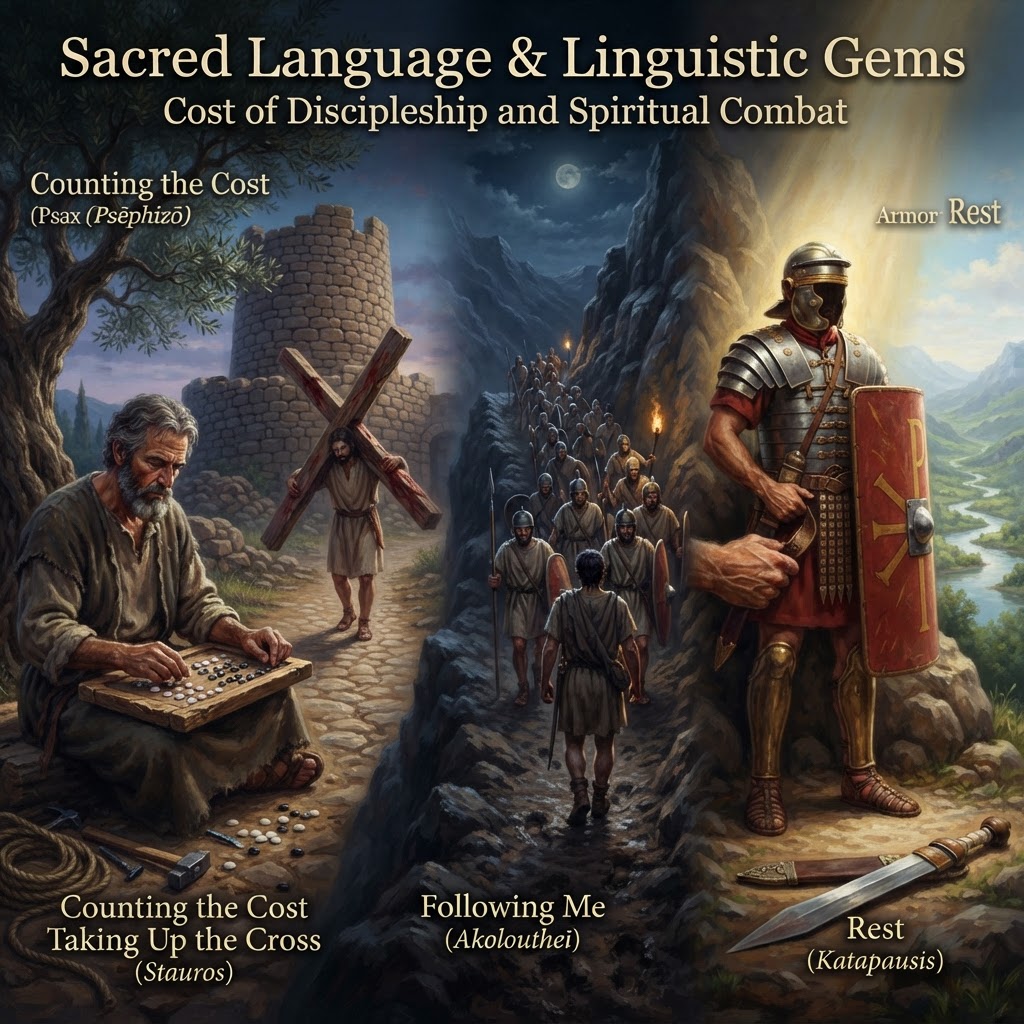
1. Ψηφίζω τὴν δαπάνην (Psēphizō tēn dapanēn) – “Count the Cost” (Luke 14:28)
Etymology & Root: The verb ψηφίζω (psēphizō) is derived directly from the noun ψῆφος (psēphos), which signifies a small, smooth stone or pebble worn down by water, found in riverbeds or along the seashore. In the ancient Greco-Roman world, these small pebbles were used for two primary cultural purposes:1. Arithmetic & Abacus Calculation: Ancient mathematicians and builders would line up smooth stones on a wooden or marble counting board (abax) to perform complex financial calculations, additions, and subtractions.2. Cast Voting in Courts: In judicial assemblies (such as the Athenian Areopagus), judges cast a white pebble (psēphos leukē) for acquittal and a black pebble (psēphos melaina) for condemnation.
Vivid Metaphor: When Jesus commands you to psēphizō, picture a master builder sitting under the shade of an ancient olive tree at twilight. He places his wooden counting slate on his knees and arranges small white stones, pebble by pebble. He counts every beam of cedar, every block of dressed limestone, every hour of manual labor, and every drop of olive oil needed to finish the tower to its high pinnacle. He does not stop counting halfway; he calculates until the last pebble is placed!
Dapanē (δαπάνη): Derived from the root daptō (meaning “to devour” or “to consume completely”). Dapanē is not a small tip or excess change; it is an outlay that devours all available resources.
Theological Reality: To count the cost of following Christ is not to make a loose financial donation; it is a meticulous stone-by-stone calculation acknowledging that discipleship will consume your whole life; your soul, your mind, your body, your reputation, your possessions, and your ultimate allegiance!
2. Αἱρέτω / Ἀράτω τὸν σταυρὸν αὐτοῦ (Airētō / Aratō ton stauron autou); “Take Up His Cross” (Mark 8:34 / Matt 16:24)
Etymology & LXX Nuance:The Greek word σταυρός (stauros) comes from the verb histēmi (“to stand upright”). It originally referred to an upright wooden stake or pole. In the LXX, the Hebrew equivalent is עֵץ (‘Etz), meaning a tree or wooden gibbet. Deuteronomic law pronounced: “Cursed is every one that hangeth on a tree” (Deut 21:23 / LXX: κεκατηραμένος ὑπὸ Θεοῦ πᾶς κρεμάμενος ἐπὶ ξύλου).
The Imperative Action: The verb ἀράτω (aratō) is an Aorist Active Imperative; demanding a decisive, immediate, once-for-all act of picking up and lifting a physical burden.
Vivid Metaphor: Picture a man standing before the execution bench in the Roman praetorium. The wooden patibulum is thrown at his feet. It is rough, raw timber, dark with bloodstains from previous condemned men, splinters sticking out from its grain. The command aratō requires him to bend his knees, place his scoured shoulders underneath the rough timber, hoist it upward onto his back, and step forward onto the cobblestone street.
Theological Reality: Taking up the cross is not enduring a minor headache, a difficult relative, or a bad day at work. It is the voluntary, deliberate act of stooping down to hoist the wooden beam of self-death onto your shoulders daily, signifying to the entire spiritual realm: “I have relinquished all rights to my own life. My ego is condemned; Christ alone reigns in me!”
3. Ἀκολουθείτω μοι (Akoloutheitō moi) – “Follow Me” (Luke 14:27)
Etymology & Root: The verb ἀκολουθέω (akoloutheō) is composed of the prefix α- (a-), expressing unity or togetherness, and κέλευθος (keleuthos), meaning “a path, road, or track.” Hence, akoloutheō literally means “walking the exact same path together as one.”
LXX & Ancient Military Usage: In ancient Greek warfare and LXX military accounts (e.g., Joshua 6; Judges 7), akoloutheō was a technical term used for soldier troops marching in tight, unified tactical rank behind their Commander (Archēgos / Hebrew: Sar).
Vivid Metaphor: Picture a line of ancient Spartan or Roman foot soldiers marching through a dark, treacherous mountain pass at night. The terrain is filled with hidden pits, sharp rocks, and enemy snares. The soldiers must place their boots in the exact footprints of the Commander walking at the head of the column. If a soldier strays two feet to the left or right, he falls into the ravine.
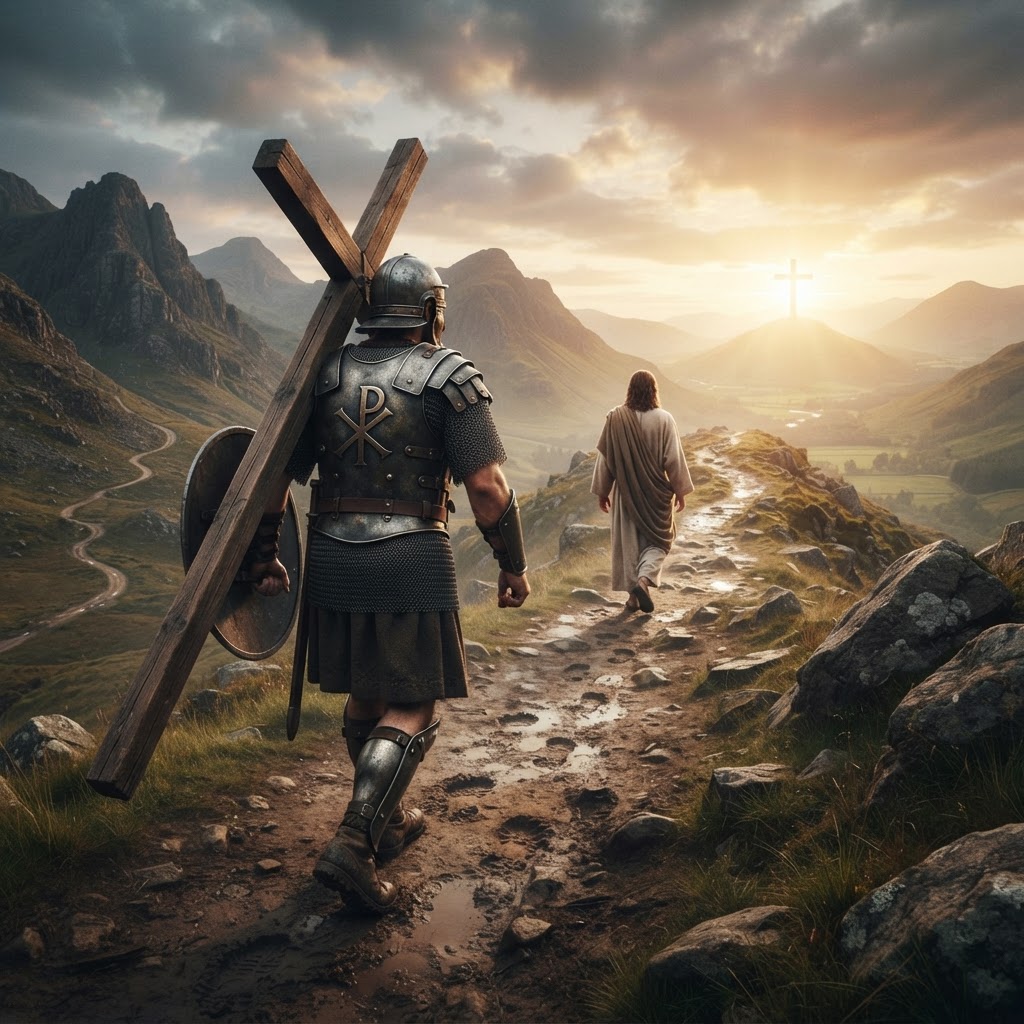
Theological Reality: Following Jesus (akoloutheitō moi) is not wandering vaguely in His general direction while chasing your own goals. It is locking your feet into the exact bloody footprints of Jesus, marching in strict tactical rank behind the Captain of your Salvation!
4. Πανοπλία τοῦ Θεοῦ (Panoplia tou Theou); “Armor of God” (Ephesians 6:11, 13)
Etymology & LXX Nuance: Composed of πᾶς (pas), meaning “all” or “every,” and ὅπλον (hoplon), meaning “weapon” or “instrument of warfare.” In classical Greek literature, the panoplia was the complete, full suit of heavy armor worn by the Greek hoplite or Roman heavy infantryman. In the LXX (e.g., 2 Samuel 2:21; Job 20:24; Isaiah 59:17), panoplia translates Hebrew terms for full military armament. Crucially, in Isaiah 59:17 (LXX), YHWH Himself puts on armor to deliver His people: “For he put on righteousness as a breastplate, and a helmet of salvation upon his head…”
Vivid Metaphor: The panoplia was not light parade clothing. It consisted of heavy bronze or iron pieces: the helmet (galea), protecting the head; the layered iron breastplate (lorica segmentata), protecting the vital organs; the heavy leather belt (cingulum), holding the core firm; the iron-nailed war boots (caligae), giving immovable traction in close combat (palē); the four-foot rectangular wooden and leather shield (scutum), soaked in water to extinguish fiery pitch arrows; and the two-edged short sword (gladius), designed for close-quarter thrusting combat.
- Theological Reality: Paul reveals that God does not give us modern, distant push-button spiritual warfare. He hands us His very own divine Panoplia! We are called to buckle on truth, righteousness, faith, and the Word of God, engaging the enemy hand-to-hand in close-quarters combat (palē), standing fast against the cosmic rulers of darkness.
5. Κατάπαυσις (Katapausis) / שַׁבָּת (Shabbat); “Rest” (Hebrews 4:1–11 / LXX Psalm 95:11)
Etymology & Root: The Greek noun κατάπαυσις (katapausis) is derived from κατά (kata), an intensifying prefix meaning “down, thoroughly, completely,” and παύω (pauō), meaning “to cease, to stop, to rest.” In the Septuagint, katapausis translates the Hebrew מְנוּחָה (Menuchah) and שַׁבָּת (Shabbat).
Ancient Context: In LXX Psalm 94:11 (KJV Psalm 95:11: “Unto whom I sware in my wrath that they should not enter into my rest”), katapausis describes the Promised Land of Canaan; a state of undisturbed rest granted to Israel only after all the enemy giants were conquered, the land was divided, and the war was finished!
Theological Reality: Eternal Sabbath rest (katapausis) is not a passive nap taken in the middle of battle. It is the glorious, triumphant rest granted to the faithful warrior upon the cessation of combat at the end of life’s earthly warfare!
V. The Redemptive Thread & Harmony with KJV/LXX Scripture
The true majesty of God’s Word shines brightest when we see how these ancient historical, linguistic, and cultural threads weave seamlessly through the canonical Scriptures, maintaining flawless harmony between the Old Covenant (LXX / Hebrew Tanakh) and the New Covenant (KJV).
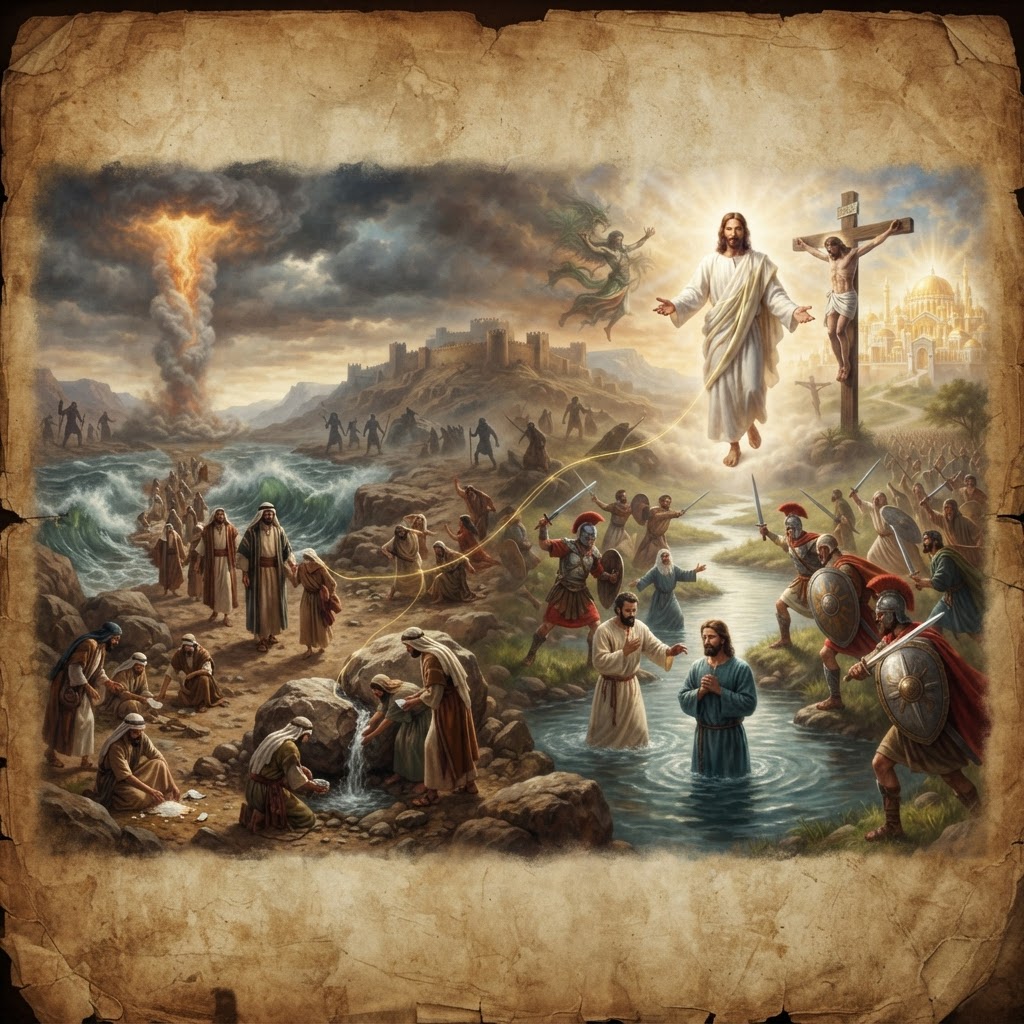
THE PARALLEL ARCS OF REDEMPTION & WARFARE
OLD COVENANT (LXX / HEBREW) NEW COVENANT (KJV)
Passover Lamb Blood (Exodus 12)
Blood of Jesus Christ (1 Pet 1:18-19)Passing through Red Sea (Exodus 14)
Water Baptism into Christ (1 Cor 10:2)Manna & Rock Water (Exodus 16-17) Spiritual Meat & Drink (1 Cor 10:3-4)Testing in Wilderness (Numbers 14) Spiritual Warfare & Trial (Heb 10:26-31)Conquest of Canaan / Anakim (Joshua) Possessing Eternal Rest (Heb 4:1-11)
1. The Typology of the Wilderness Generation (1 Corinthians 10:1-12)
Let us lay the text of 1 Corinthians 10:1-5 (KJV) side-by-side with its Septuagint roots:
“Moreover, brethren, I would not that ye should be ignorant, how that all our fathers were under the cloud, and all passed through the sea; And were all baptized unto Moses in the cloud and in the sea; And did all eat the same spiritual meat; And did all drink the same spiritual drink: for they drank of that spiritual Rock that followed them: and that Rock was Christ. But with many of them God was not well pleased: for they were overthrown in the wilderness.” (1 Corinthians 10:1-5 KJV)
Look at the divine harmony! The Apostle Paul systematically deconstructs the “ticket to heaven” delusion by demonstrating that the wilderness generation possessed every spiritual privilege imaginable:
- Redemption: They were delivered by the blood of the Paschal Lamb (Exodus 12).
- Baptism: They passed through the waters of the Red Sea under the Shekinah Cloud (Exodus 14).
- Sacramental Nourishment: They ate the heavenly Manna (Bread of Angels / LXX: ἄρτον ἀγγέλων – Ps 77:25) and drank supernatural water flowing from the struck Rock (Horeb).
Yet, despite these supernatural experiences, their corpses were scattered across the desert floor (LXX Numbers 14:16: κατέστρωσεν αὐτοὺς ἐν τῇ ἐρήμῳ; “He strewed them across the desert”).
Why? Because when the moment arrived to fight the giant clans of Canaan; when the call went out to count the cost, take up their weapons, and conquer the promised inheritance; they succumbed to spiritual sloth, shrank back in cowardice, craved the flesh-pots of Egypt, and murmured against the Lord!
Paul explicitly warns the New Testament Church in verse 12:
“Wherefore let him that thinketh he standeth take heed lest he fall.” (1 Corinthians 10:12 KJV)
2. The Sobering Warning of Hebrews 10:26-31
This canonical harmony echoes with thunder in the Epistle to the Hebrews. Read carefully the apostolic warning:
“For if we sin wilfully after that we have received the knowledge of the truth, there remaineth no more sacrifice for sins, But a certain fearful looking for of judgment and fiery indignation, which shall devour the adversaries… It is a fearful thing to fall into the hands of the living God.” (Hebrews 10:26–27 & 10:31 KJV)
In the original Jewish context of Hebrews, “sinning willfully” (hekousiōs hamartanontōn) was not referring to a momentary slip of weakness over which a believer grieves and repents. It was referring directly to the high-handed sin of apostasy described in Numbers 15:30 (LXX: ψυχὴ ἥτις ποιήσει ἐν χειρὶ ὑπερηφανίας; “the soul that doeth ought presumptuously/with a high hand”). It is the deliberate, defiant rejection of Messiah’s enlistment; a soldier casting off his armor, trampling the blood of the covenant underfoot, and deserting the ranks to return to the kingdom of darkness!
Scripture leaves no room for a passive, lazy, or rebellious faith. Faith; πίστις (pistis) in Greek, אֱמוּנָה (Amanah / Emunah) in Hebrew; is not mere passive intellectual agreement with a set of doctrines. In ancient royal and military inscriptions, pistis was the technical term for active allegiance, loyalty, and covenantal fidelity to the King!
True faith is an allegiance that enlist in Christ’s army, takes up the cross daily, and perseveres (hypomonē) through battle until the victory is won!
3. Messiah Jesus: The Ultimate Archēgos and Joshua
Where Israel in the wilderness failed, Jesus Christ, our glorious Lord, triumphed completely!
Jesus entered the wilderness for forty days, confronted the Great Dragon (Satan), wielding the sword of the Word (“It is written”), and completely vanquished the enemy!
Jesus counted the cost in the Garden of Gethsemane (Luke 22:42), where His sweat became as great drops of blood, crying: “Father, if thou be willing, remove this cup from me: nevertheless not my will, but thine, be done.” He drank the full cup of dapanē (total expenditure) to redeem us!
- Jesus picked up His stauros, carried it to Golgotha, allowed His hands and feet to be pierced, spoiled principalities and powers, and made a show of them openly, triumphing over them in it (Colossians 2:15)!
Jesus is our Ἀρχηγός (Archēgos); the Supreme Captain, Pioneer, and Champion of our Salvation (Hebrews 2:10 and Hebrews 12:2). He does not command us to march anywhere He has not already trod! He leads us out of the wilderness of sin, through the river of baptism, through the fires of spiritual combat, and directly into the eternal Promised Land of God’s presence!
VI. Holy Spirit Application & Call to Pursuit
My dear, precious student, we have journeyed together through the Roman streets of Judaea, through the Qumran caves, through the linguistic depths of the Greek and Hebrew texts, and through the thunderous warnings of the Apostles. Now, the Holy Spirit brings this living revelation straight into your heart today!
Ask yourself before the searchlight of God’s Holy Spirit:
Have you been settling for a cheapened “ticket to heaven” mentality; a passive, comfortable religion that costs you nothing, changes nothing, and fights nothing?
Or have you sat down with the counting stones (psēphizō), calculated the total outlay of your life, surrendered your ego, and hoisted the cross beam onto your shoulders?
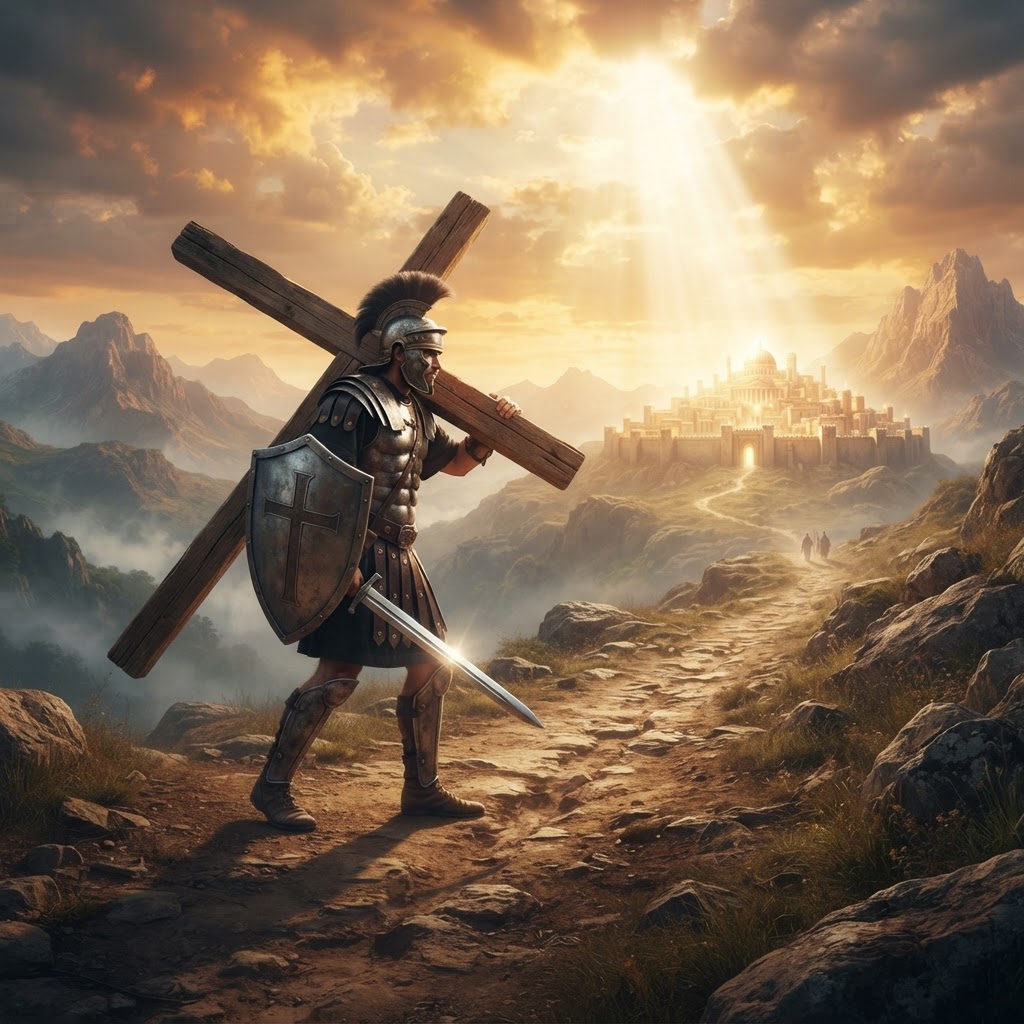
The battle cry of the Kingdom is sounding across the earth today! The Lord God of Hosts (Adonai Tzva’ot) is assembling His end-time army. He is not looking for half-hearted onlookers or spiritual tourists; He is looking for devoted, Spirit-filled warriors who will put on the full armor of God (Panoplia), lock their boots into His footsteps (Akoloutheō), stand firm against the darkness of this world, and possess the inheritance of the saints!
Do not shrink back from the cross, my beloved! For the cross is not the end of joy; it is the birth of true, indestructible Life! When your self-will dies upon that cross, the supernatural resurrection life and power of Jesus Christ floods into your mortal body! When you lose your life for His sake, you find the glorious, unstoppable, triumphant life that death itself can never touch!
A Holy Spirit Prayer of Consecration & Fire
(Pray this out loud from the depths of your heart right now!)
“Oh Lord God of Abraham, Isaac, and Israel, the Great and Terrible God who keeps covenant and mercy! I bow my heart before Your glorious Throne of Grace today in the mighty Name of Jesus Christ.
Holy Spirit, search my heart! Forgive me for every time I have settled for a passive, comfortable, cheapened religion. Forgive me for shrinking back from the battle, for clinging to my own self-will, and for desiring the gifts of Your kingdom without surrendering my life to Your King!
Today, Lord Jesus, I sit down at Your feet and count the cost. I cast away every compromise, every idol, and every earthly security. I yield my life, my heart, my mind, my money, my ambitions, and my future entirely to Your Lordship!
I take up my cross today! I hoist the rough-hewn beam of self-surrender onto my shoulders. I declare that I am crucified with Christ: nevertheless, I live; yet not I, but Christ lives in me!
Clothe me with Your Panoplia, Your holy armor of light! Gird my waist with Truth, cover my chest with Righteousness, shoe my feet with the readiness of the Gospel, place upon my head the Helmet of Salvation, lift up in my hands the Shield of Faith, and put into my mouth the sharp Sword of Your Word!
I lock my feet into Your footprints, my glorious Captain! I will march behind You without turning back. I will stand against the giants of darkness in this generation, and by Your precious Blood and the Word of my testimony, I will overcome!
Ignite my soul with fresh fire! Give me an unquenchable hunger for Your Holy Scriptures. Lead me through the battle into Your eternal Shabbat rest, to the praise of the glory of Your Grace!
In the exalted, triumphant, and holy Name of Messiah Jesus I pray and decree it… AMEN AND AMEN!”
Summary Checklist for Spiritual Meditation & Study
To retain and meditate upon these truths, keep these five core revelations before your eyes:
- Psēphizō tēn dapanēn (Luke 14:28): Sit down daily to calculate total self-surrender; discipleship requires your entire life, not excess spare time.
- Aratō ton stauron (Mark 8:34): The cross is a one-way execution of the ego; hoisting it daily signals total death to self-ownership and total life in Christ.
- Akolouthei moi (Luke 14:27): March in strict, locked tactical rank behind Jesus, placing your boots directly in His word and footsteps.
- Panoplia tou Theou (Ephesians 6:11): Put on the full heavy armor of YHWH for close-quarters spiritual warfare (palē).
- Katapausis (Hebrews 4:11): Fight the good fight of faith with ultimate joy, knowing that eternal rest awaits the victorious saint at the end of the march!