
Your cart is currently empty!
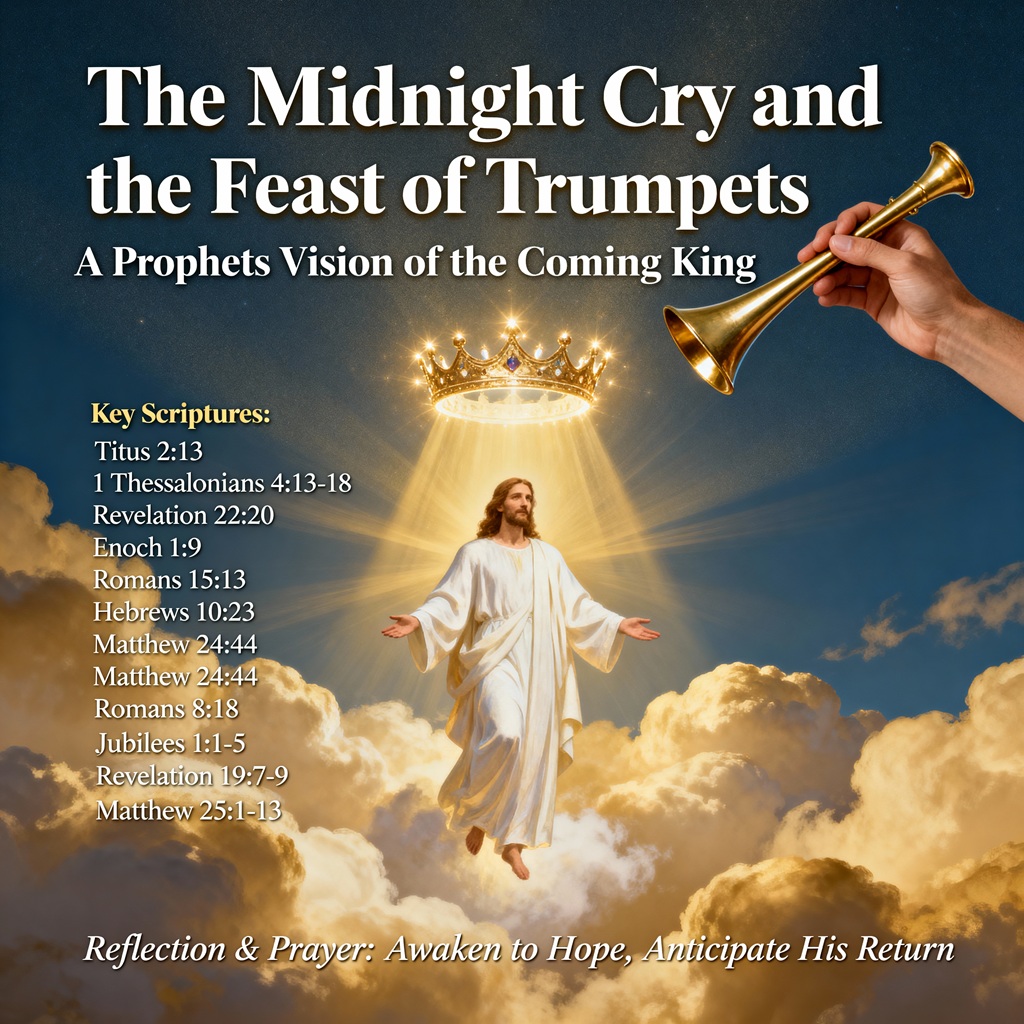
Awakening to the Midnight Cry and the Feast of Trumpets Chapter 8
Chapter 8
Go to Chapter – 1, 2, 3, 4, 5, 6, 7, 8.
The Glorious Appearing and Eternal Celebration
As we approach the threshold of eternity, the resonant message of the “Midnight Cry” echoes through the corridors of time, beckoning the Bride of Christ to prepare for the magnificent culmination of all creation. The Feast of Trumpets invites us into a state of readiness, stirring our hearts to anticipate the majestic return of our King. From the sacred scrolls nestled in the caves of Qumran to the profound revelations granted to John on the Isle of Patmos, the expectation of Christ’s return vibrantly pulses through every sacred text. This chapter will illuminate four awe-inspiring aspects of that eternal celebration: Heaven’s glorious architecture, the Marriage Supper of the Lamb, the renewal of creation, and our eternal assignments. Together, let us explore the depths of biblical revelation, the wisdom of Second Temple writings, and the insights of the early church, igniting within us a spirit of holy wonder and earnest expectation.
1. Heaven’s Architecture: The New Jerusalem and the River of Life
The Scriptures unveil a breathtaking vision of the eternal city. In Revelation 21–22, John describes walls adorned with jasper, gates made of pearls, and streets paved with pure gold. The Book of Jubilees (chapter 23) echoes this imagery, declaring, “He showed me the foundations of twelve precious stones, shining with every color of light.” 1 Enoch 90:28–29 expands this vision, illustrating how the “Elect One” causes the river of life to flow forth, sparkling like crystal. The “Temple Scroll” from the Dead Sea Scrolls (11QTemple) affirms that God’s presence will dwell among His people on a renewed earth, reflecting heaven’s perfection.
The early church fathers resonate with these truths. Irenaeus, in his work “Against Heresies” (5.30.4), asserts that the New Jerusalem is “prepared as a bride adorned for her husband,” drawing inspiration from Isaiah 62:5 and Ezekiel’s temple vision (Ezekiel 40–48). Together, these ancient voices reveal not only the city’s dimensions – 12,000 stadia (Revelation 21:16) – but its very essence: unbroken communion with the Lamb, the flowing river of life, and the healing leaves of the tree of life.
2. The Marriage Supper of the Lamb: Intimacy, Joy, Celebration
As the Feast of Trumpets resounds, the hidden Bride hears the shofar’s call. When Christ appears, she emerges clothed in pure, white garments (Revelation 19:7–9). The Book of Jasher poetically depicts this union, likening it to Israel at Sinai, where she stands in awe, hearts aflame with holy reverence. 1 Corinthians 2:9–10 reminds us that no eye has seen what God has prepared for those who love Him – a gentle yet earnest warning to keep our lamps trimmed and our hearts vigilant (Matthew 25:1–13).
In 1 Enoch 62:8, we are invited to a celestial banquet, “a feast of righteousness for the chosen,” where patriarchs and prophets gather in joyous communion. Justin Martyr, in his “Dialogue with Trypho” (chapter 80), applies this banquet to the end times, urging believers to “rejoice with trembling, for we go forth to meet our Lord.” The Marriage Supper thus becomes both a celebration of union and a solemn covenant, embodying joy in our connection with Christ and awe before His unveiled holiness.
3. All Things New: Restored Creation and Redeemed Relationships
The consummation of all things is indeed cosmic. Isaiah’s vision (Isaiah 65:17–25) and Revelation 21:1 converge in the promise of a new heaven and a new earth, where sorrow and death are banished. The Dead Sea Scrolls’ “War Scroll” (1QM) anticipates a final battle, after which “all nations shall walk in the light of your glory” (Isaiah 60:3), underscoring that creation itself will be liberated from its bondage (Romans 8:21). Jubilees (chapter 23) envisions the restoration of Eden as the fulfillment of God’s jubilee – an eternal Sabbath.
Jewish traditions preserved in the Book of Gad (fragments in DSS 4QGeda) speak of “the healing tree” whose leaves bring life renewal – a motif echoed by John in Revelation 22:2. We envision not only vibrant forests and radiant rivers but also reconciled families and nations clothed in garments of praise (Zechariah 8:23). The early Christian homilies, such as those by Clement of Alexandria (Miscellanies 8.25), proclaim that even the stars will sing, and every creature, from the depths of the sea to the highest peaks, will lift its voice in unending worship.
4. Our Eternal Assignment: Worship, Work, and Fellowship Forever
Ultimately, the consummation is not a passive rest; it is an active flourishing in God’s presence. Revelation 22:3 proclaims, “His servants will serve him, and they shall see his face.” The Book of Enoch (1 Enoch 40–48) describes the “Elect One” assigning each angel and human servant their place – a divine order for the new creation. Early church fathers like Hippolytus (On the Twelve Prophets) discerned in these texts a foreshadowing of the saints’ ministries: teaching angels, stewarding creation, and magnifying the glory of God throughout eternity.
Malachi 3:1 warns us of the Lord coming suddenly to His temple, purifying and then remembering His covenant. In the age to come, that purification will be complete, and we will find ourselves as priests in an everlasting sanctuary (Revelation 7:15). The apocryphal Ecclesiasticus (Sirach 51:27) assures us that wisdom endures forever, with the righteous “shining forth as sparks among the stubble” (Sirach 46:1). Our eternal assignment involves worship that never fades, works that never tire, and fellowship that never ceases.
Conclusion and Call to Action
Beloved, the trumpet still sounds. From the scrolls buried in desert caves to the apostolic canon, one refrain echoes: “Behold, He comes swiftly” (Revelation 22:20). Ancient texts beckoned their original readers to live with vigilant hope, holy lives, and sacrificial love – and they call us to the same today. In the light of the New Jerusalem, will we inscribe our names on its gates by loving our neighbors? At the threshold of the Marriage Supper, will our lamps shine brightly with deeds of mercy? As creation itself groans for freedom, will we embrace our roles as stewards of renewal?
Awake, dear Bride. Tune your heart to the gentle yet profound trumpet call of the Holy Spirit. Prepare your spirit, adorn your life with righteousness, and take your rightful place in the eternal song. “Let us rejoice and exult,” writes John, “and give Him the glory” (Revelation 19:7). The midnight hour wanes, the trumpets call – our King is coming. Let us rise to meet Him with joyful anticipation.
Conclusion: Watching, Waiting, Stewarding What He’s Given
Beloved, we find ourselves on the threshold of eternity, our spirits stirred by the clarion call of the Midnight Cry and the Feast of Trumpets. As Hebrews 10:25 compels us, “not neglecting to meet together, but encouraging one another,” let us gather in holy expectancy, watching and waiting for the Bridegroom’s arrival. From the earliest pages of Scripture through the prophetic visions, God has beckoned His people to readiness: “Behold, He is coming with the clouds” (Revelation 1:7). This chapter has urged us to examine our lamps, trim our wicks, and fill our vessels with the oil of the Spirit (Matthew 25:1–13). Drawing from a rich treasury of biblical and ancient witnesses – the Book of Enoch, the Dead Sea Scrolls, the Book of Jubilees, the Book of Jasher, the Book of Gad, and the wisdom of second-century Fathers – we conclude our journey with a heart of loving urgency, faithful warning, and devoted stewardship.
Prophetic Foundations from Ancient Scrolls
From Enoch’s visions to the covenant libraries at Qumran, the ancient texts resonate with a singular call: watchfulness. In 1 Enoch 62, the prophet beholds “the Son of Man” enthroned before the Ancient of Days, resonating with Daniel 7:13 and Revelation 14:14. The Dead Sea Scrolls’ War Scroll (1QM) encourages the Sons of Light to “stand fast like the foaming sea, awaiting the day of visitation,” mirroring Jesus’ admonition in Mark 13:37, “What I say to you, I say to all: Watch!” Jubilees 6:25 reminds us that God “appointed the festivals in their seasons,” that His people might remember the times of waiting and the appointed moments of redemption. The Book of Jasher (chapter 86) captures the patriarchs raising their eyes to the heavens, urging one another: “Let us not sleep in slumber, but watch the signs of the firmament.” Even the lesser-known Book of Gad heralds the trumpets of the end as a call to holiness: “Sound the alarm, that the righteous may purify their garments” (Gad 11:5).
Wisdom from the Second-Century Voices
The early church Fathers, steeped in both Jewish tradition and apostolic teachings, emphasized the urgency of being prepared. Irenaeus of Lyons (Against Heresies 5.28.3) asserted that the Church’s era is “but a single day,” with “the Lord imminent to return.” Hippolytus (Commentary on Daniel) discerned in the four kingdoms of Daniel a foreshadowing of end-time tribulation, concluding that “we must watch for the coming of the righteous Judge.” Tertullian (On the Resurrection of the Flesh 50) implored believers to “awake from sleep and cast away the works of darkness.” Clement of Alexandria (Stromata 7.17) drew upon both Scripture and Hermetic traditions to depict the soul’s awakening at the midnight trumpet’s sound. These voices converge with the New Testament’s beatitude: “Blessed are those who are invited to the marriage supper of the Lamb” (Revelation 19:9).
Interpreting the Signs of Our Era
We find ourselves amidst unprecedented cultural, political, and moral shifts. Wars and rumors of wars (Matthew 24:6), pestilences (Luke 21:11), and moral decay (2 Timothy 3:1–5) align with the patterns prophesied in Joel 2’s cosmic disturbances and Zephaniah 1’s trumpet in Zion. The Book of Jubilees foretells “the nations gathering as clouds” around Jerusalem (Jubilees 23:16), reflecting Revelation 16’s gathering at Armageddon. The Book of Gad notes the rise of global rulers whose ambitions blind them to the day of the Lord (Gad 9:8). Yet these signs do not incite fear; they provoke steadfast trust. As the prophet Habakkuk proclaimed, “Though the fig tree should not blossom… yet I will rejoice in the Lord” (Habakkuk 3:17–18). The Dead Sea Scrolls’ Rule of the Community (1QS 4:22) counsels, “Be sober, be watchful, hope in His goodness.”
Spiritual Readiness: Heart, Home, and Community
Our call is threefold: prepare your heart, steady your home, and strengthen your community. Paul exhorts us in 1 Thessalonians 5:6–8 to “put on the breastplate of faith and love, and for a helmet the hope of salvation.” The Book of Jasher warns that “a heart divided will neither see nor hear the trumpet of joy” (Jasher 77:4), urging us toward undivided devotion. The Feast of Trumpets in Leviticus 23:24–25 is both a corporate gathering and an alarm for individual sanctification. Jubilees instructs families to assemble “with lamps trimmed,” symbolizing our unity as the body of Christ awaiting His appearing (Jubilees 6:17). The early church embodied mutual aid – echoed in Acts 2:44–45 and in 1QS 5:9’s call to “care for the widows and the poor” – creating a community of tangible love that reflects the age to come.
Prophetic Voice and Pastoral Shepherding
In a world awash with competing prophecies, let us cling to the tested word. Paul’s exhortation (2 Peter 1:19) remains: “We have the prophetic word more fully confirmed.” The Gift of Prophecy, as outlined in 1 Corinthians 14:3–5, is meant “for building up and encouragement.” The Book of Enoch advises discernment: “Do not speak rashly, for the Spirit of truth is the breath of life” (Enoch 108:2). The Rule at Qumran (1QS 11:15–16) establishes protocols for testing prophetic utterances within an accountable council. Such wisdom protects us from sensationalism and positions us to receive true revelation, growing in the stature of Ephesians 4:13 until we all attain “to the unity of the faith and of the knowledge of the Son of God.”
A Vision of Eternal Celebration
As the dawn of the Bridegroom’s day approaches, we catch glimpses of the New Jerusalem’s river of life (Revelation 22:1–2) and hear the voice beckoning, “Come up hither” (Revelation 4:1). Isaiah 25:6–9 celebrates the feast God prepares “for all peoples,” erasing death forever. The Book of Jubilees envisions Eden renewed, “where there shall be no sorrow nor sighing” (Jubilees 23:30). The Book of Gad declares, “All tears shall be wiped away; joy shall fill the courts of heaven” (Gad 12:3). Such visions fuel our endurance, anchoring us in hope that will not disappoint (Romans 5:5). We are pilgrims journeying toward that city whose builder and maker is God (Hebrews 11:10).
A Call to Watch, Pray, and Steward
Dear ones, the hour grows late. The trumpets of awakening resound across the ages – from Leviticus to Jubilees, from Enoch’s revelations to John’s apocalypse, from the Qumran community to the earliest church councils. He who is faithful has promised, “I am coming soon” (Revelation 22:20). Will you heed the midnight cry? Will you sound the alarm in your generation? Let us:
– Watch expectantly, keeping our lamps aflame with prayer (Matthew 26:41).
– Sanctify our homes and invest in kingdom community (1 Timothy 3:15).
– Declare the gospel with prophetic boldness and pastoral compassion (Acts 2:17–18).
– Practice justice, love mercy, and walk humbly before God (Micah 6:8).
– Steward the revelations entrusted to us until He returns (1 Corinthians 4:1–2).
May the Holy Spirit empower you to live in holy urgency and radiant hope. May the ancient voices – Enoch, Jubilees, Jasher, Gad – and the apostles, prophets, and Fathers harmonize their testimony with the Word of God. Then, when the Bridegroom calls, we will join the unending feast, proclaiming with all creation, “Even so, come, Lord Jesus!” (Revelation 22:20). Amen.