
Your cart is currently empty!

8/14/2026 Teaching on Luke 21:34 OVERCHARGED (βαρυνθῶσιν) (barynthōsin)

OVERCHARGED
Unshackling the Eagle’s Wings for Christ’s Imminent Return “The Weight That Keeps Us Grounded”
I want you to do something with me. Just for a moment, I want you to stop. Stop fidgeting. Stop thinking about what you’re going to do when you walk out of here. Stop rehearsing the conversation you had at supper. Stop making your mental list for tomorrow morning. I know the list is there. I know it’s long. But for the next hour, the list can wait. The Lord wants your heart.
Father, we thank You that You are the God who lifts. You are the God who raises up the poor from the dust and lifts the needy from the ash heap. And tonight, Lord, some of us came in heavy. Some of us came in carrying things we didn’t even know we were carrying. We didn’t plan to be heavy. We just… accumulated. And so, Father, we ask You to do what only You can do. Settle us in Your presence. Let the wind of Your Spirit stir the feathers of our souls. And as we open Your Word, would You show us what needs to fall away, so we can fly again. In Jesus’ name. Amen.
Let me paint you a picture before we read anything.
Picture a magnificent eagle. I mean, really picture it. This is the king of birds, the creature that the ancients called the prince of the air. An eagle is born for the updrafts. It is designed for the high places. It does not hop along the ground like a sparrow. It does not scratch in the dirt like a hen. It is built to catch the thermals (those invisible columns of rising air) and ride them, circling higher and higher, until it can look into the very face of the sun. A full-grown eagle can soar above the storm. It can fly so high that the clouds are beneath its wings. That is its design. That is its glory. That is what it was made to do.
Now. Imagine that eagle with its feathers coated in thick, heavy, wet mud. Imagine clay (wet, clinging, sticky clay) caked into every feather, layered on its wings, matted on its breast. Can you see it? It tries to lift off. It spreads those wings, but they’re heavy. It beats them, but they’re bogged down. It cannot fly. It can only drag its heavy body through the dirt, wings trailing, feathers dragging, vulnerable to every predator that comes near. A magnificent creature, designed for the heavens, reduced to crawling in the mud.
Keep that picture. Hold on to it. Because that is the picture Jesus Himself paints for us tonight, not of an eagle, but of a heart.
Now let’s read the text. Luke chapter twenty-one, beginning at verse thirty-four. This is the Lord Jesus speaking, and He is at the end of His ministry. He has been teaching about the last days, about the signs, about the end of the age. And then He stops the prophecy and He turns to His disciples (and to us) and He gives a warning. Hear it:
“And take heed to yourselves, lest at any time your hearts be overcharged with surfeiting, and drunkenness, and cares of this life, and so that day come upon you unawares.”
Take heed to yourselves.
Now, that Greek word that gets translated “overcharged” and some of your versions will say “weighed down” or “dulled” or “burdened”, the Greek word is βαρυνθῶσιν, barynthōsin. Say it with me. Ba-ryn-THO-sin. It comes from the root barus, which means heavy, weighty, burdensome. And barynthōsin means to be made heavy, to be burdened, to be weighted down. To become so laden that you can no longer rise.
It’s the same word the Gospel writers use in the Garden of Gethsemane, when the disciples’ eyes were heavy with sleep. Do you remember that? Jesus is sweating blood, agonizing in prayer, and He comes back to His disciples, and they are heavy(barynthōsin) their eyes weighed down, their spirits waterlogged, unable to watch with Him even one hour.
And here in Luke twenty-one, Jesus says: your heart can get that way. Your heart can become overcharged. Your heart can become heavy. And a heavy heart cannot rise.
That’s the picture. The eagle was made to soar, and the eagle is dragging through the dirt with mud on its feathers. That is a barynthōsin heart, a heart waterlogged by the world.
So let me ask you the first question, and I want you to answer it honestly, not out loud, just between you and God.
If an eagle is born for the updrafts, born for the high places, born for the thermals that carry it into the very face of the sun, what does that tell you about how God originally designed the human heart?
Think about it. You were not designed for the mud. You were not designed to crawl. Listen to me now, because this is important: God did not design you to live at ground level. The Psalmist said, “He maketh me to dwell in safety”; but that’s not all. Isaiah says, “They that wait upon the Lord shall renew their strength; they shall mount up with wings as eagles; they shall run and not be weary; and they shall walk and not faint.”
They shall mount up. With wings. As eagles.
God designed the human heart for the high places. He designed you for communion with Himself; for that secret place where the Spirit meets the spirit. He designed you to dwell in the secret place of the Most High, to abide under the shadow of the Almighty. He designed you to ascend into His hill, to stand in His holy place. He designed you for worship that lifts, for prayer that soars, for a walk that is not dragged along the ground but lifted up into the heavenlies.
Child of God, in what ways has He created you to soar? Think about the gifts He put in you. Think about the love He planted in you. Think about the joy that used to bubble up in you. Think about the faith that once moved mountains. Think about the peace that passes understanding. Those are the updrafts of a soul made in the image of God. You were not made to crawl. You were made to fly.
And yet (and here’s the tragedy) somewhere along the way, the mud got on the feathers.

The Mud on the Feathers
So, let’s talk about the mud. The mud is not usually the big, obvious thing. Nobody here tonight, I suspect, came in saying, “I have decided to abandon the Lord and live in open rebellion.” No. Most of us came in saying, “I love Jesus.” And we do. But the eagle didn’t choose the mud either. The mud just… got on it. Rain fell. Ground splashed. It walked through a puddle it shouldn’t have walked through, and the next thing it knew, its feathers were coated.
What are the muds in your life right now? Not the big, glaring sins (though those are mud too, and we’ll get to them) but the subtle, worldly coatings that you hardly notice until you try to lift your wings in prayer. That’s the key test, by the way. You don’t know how heavy the mud is until you try to fly. You can carry a weight for a long time and not feel it; until you try to worship, until you try to pray, until you try to open the Word and suddenly you realize your wings won’t lift.
So, here’s my question for you, and I want you to let it sit on your mind: What has gotten caked onto your feathers?
Is it the television that’s on from the moment you wake until the moment you sleep? Is it the noise? Oh, the noise. We live in a noisy world, and it gets louder and louder, doesn’t it? The radio in the car, the television in the living room, the telephone ringing, the music playing, the voices of everybody else telling you what to think and what to fear and what to buy. And somewhere in all that noise, the still, small voice becomes hard to hear.
Is it the food? The refrigerator at midnight? The snack that has become a habit, the habit that has become a comfort, the comfort that has become a god?
Is it the schedule? The running? The rush? The sense that if you stop for even an hour, everything will fall apart?
Is it the resentment you’re nursing? The offense you’re rehearsing? The conversation you keep replaying in your head; what they said, what you should have said back?
Is it the worry; the endless, churning worry?
We’re going to name these things one by one, because Jesus names three weight-givers, and He doesn’t name them for no reason. He names them because He knows exactly where the mud comes from.

Weight-Giver Number One: Surfeiting
Jesus says your heart can be “overcharged with surfeiting.” Now that’s the King James word. Some of your newer versions call it “carousing” or “dissipation.” The Greek word here is kraipalē and it’s a vivid word. It literally pictures a head spinning from excess. It’s the dizzy, dull, foggy stupor that comes from overindulgence; a hangover, if you want the blunt translation, but not just from drink. Kraipalē is the fog of having had too much of anything. Too much food. Too much drink. Too much pleasure. Too much entertainment. Too much of the world’s table.
And here’s what I want you to see: surfeiting doesn’t have to look like a party. It doesn’t have to look like a wild orgy of sin. Surfeiting looks like drowning yourself in entertainment. It looks like filling every spare moment with something (anything) to keep from being still before God.
You see, the enemy doesn’t care how he weighs you down. He doesn’t care if it’s a sin or a legitimate pleasure taken to excess. He doesn’t care if it’s the bar or the buffet. He doesn’t care if it’s the nightclub or the remote control. All he cares about is that your heart gets heavy. All he cares about is that when you finally do get quiet before the Lord and I’m going to say something that might sting; all he cares about is that you’ve trained yourself to be so uncomfortable with stillness that you’ll reach for anything to avoid it.
Be honest. When was the last time you sat in silence before the Lord for more than five minutes? Not praying a list. Not reading. Just… sitting. Settling. Waiting on Him. When was the last time you were quiet enough to hear Him?
I’ll tell you what it looks like when surfeiting has its way. You sit down to pray, and within thirty seconds your mind is wandering to the ballgame. You open the Bible, and you read a verse, and before you’ve finished the verse you’re thinking about what you’re going to have for dinner. You try to worship, and it feels flat, dry, hollow. Why? Because your head is spinning. Because you’ve overfilled yourself with the world’s table, and there’s no room left for the bread of heaven. The eagle’s head is down. It’s dizzy by excess. It can’t lift its eyes.

Weight-Giver Number Two: Drunkenness
The second weight-giver Jesus names is “drunkenness.” Now, I know what you’re thinking. “Well, I don’t drink, so this one doesn’t apply to me.” And yes, let’s be plain: drunkenness with alcohol is a sin, it is a weight, and if that’s your struggle, then you need to deal with it honestly before God tonight. But listen (because I want you to hear this), I believe Jesus is pointing at something broader here. There are other spirits that intoxicate us besides alcohol.
There is a drunkenness of busyness. Oh, this is a big one in our day. I look around at God’s people, and I see so many of you intoxicated with activity. You’re drunk on your schedule. You’re drunk on your accomplishments. You’re drunk on the adrenaline of always having something to do, somewhere to be, someone to impress. And here’s the thing about being drunk: a drunk man doesn’t realize he’s drunk. He thinks he’s fine. He thinks he’s walking straight. He thinks his words are clear. And everybody around him knows better.
That’s what busyness does. It gives you a false sense of importance. It makes you feel like you’re doing something for God (and maybe you are) but underneath it all, it’s a way of avoiding the one thing He actually wants: your heart. The drunk man staggers, but he thinks he’s in control. The busy Christian rushes, but deep down, he’s running from the quiet place where God would search him.
There is a drunkenness of the praise of men. Oh, that’s an intoxicating drink, isn’t it? To be noticed. To be appreciated. To be applauded. To have someone say, “You’re doing a wonderful job.” And before you know it, you’re living for the next compliment. You’re checking to see who saw what you did. You’re measuring your worth by what people say about you. That’s a spirit that intoxicates, and a heart drunk on the praise of men can’t hear the voice of God, because the two voices are always competing, and you can only truly serve one master.
There is a drunkenness of adrenaline, the thrill seeker’s high, the addiction to drama, the craving for the next crisis. Some of you are addicted to crisis. If life is calm for two days, you start stirring something up, because you can’t stand the quiet. You’ve been drunk on the excitement for so long that the presence of God feels boring to you. Let me tell you something: if the presence of God feels boring, you’re not sober. You’re intoxicated on something else.
And there is a drunkenness of the world’s values, the intoxicating dream of more. More money. More stuff. More comfort. More security. The world holds up this cup and says, “Drink this, and you will be happy.” And we drink, and we stagger, and we think we’re advancing, when all the while, our wings are getting heavier.
So, let me ask you: what spirit is intoxicating besides alcohol? What is making you stagger through life thinking you’re fine when you’re not? Because Jesus names it, and if He names it, it’s real, and if it’s real, we’ve got to face it.

Weight-Giver Number Three: The Cares of This Life
And then the third one; and here’s the sneakiest one of all. Jesus says the heart can be overcharged with “cares of this life.” The Greek word is merimnais; anxieties, worries, distractions. The word Jesus uses elsewhere for “take no thought”; mē merimnate. Don’t be anxious. Don’t let your heart be pulled apart by worry.
Now here’s where it gets sneaky, because worry wears a mask of responsibility. Worry says, “I’m just being prudent.” Worry says, “Somebody has to think about these things.” Worry says, “If I don’t worry about it, who will?” And it feels so responsible, doesn’t it? It feels so mature, so adult, so wise. But let me tell you what worry really is, according to the Lord Jesus Christ.
Worry is the endless churn of tomorrow’s problems today. And Jesus says that’s not faith; that’s the weight that glues your wings to the ground.
Think about it. You can’t change tomorrow by worrying about it today. You cannot add one cubit to your height by taking thought. You cannot make the sun rise earlier or the bills get paid faster by rehearsing them at 2 a.m. Worry changes nothing except you. It steals your sleep. It steals your peace. It steals your joy. And worst of all, it steals your trust; because every hour you spend worrying is an hour you’re telling God, “I don’t believe You can handle this.”
And the cares of this life are so sneaky because they’re so legitimate. The mortgage. The children. The job. The health. The future. These are real things. These are real responsibilities. And that’s exactly why the enemy loves them. He takes a legitimate concern, and he amplifies it into an anxiety. He takes a thought, and he turns it into a churn. And before you know it, your mind is a washing machine full of tomorrow’s problems, spinning and spinning, and you can’t get still, and you can’t get free, and you can’t get your eyes on Jesus.
Listen to me. The Lord cares about your cares. He said, “Cast all your care upon Him, for He cares for you.” He didn’t say you wouldn’t have cares. He said you can give them to Him. But you can’t give Him what you refuse to let go of. And a heart that’s clenched around its worries is a heart that can’t lift its wings.

The Waterlogged Heart
Now. Put it all together. Surfeiting; the fog of excess. Drunkenness; the stagger of intoxication, whether it’s busyness or praise or adrenaline. And the cares of this life; the endless churn of anxiety. Add them up, and you get a barynthōsin heart. A heart that is heavy. A heart that is waterlogged by the world.
And let me ask you: what does it feel like when your heart is waterlogged? Because I think every one of us in this room has felt it, even if we couldn’t name it. Let me describe the spiritual sensations, and you tell me if I’m describing you.
Heaviness in worship. You stand up to sing, and you know the songs. You love the songs. But there’s a weight on your chest, and the words come out flat. The joy is gone. You’re going through the motions, and you wonder why everybody else seems to feel something you don’t feel.
Fog in prayer. You try to pray, and it’s like trying to see through a window that’s steamed over. The words don’t come. The connection feels broken. You know God is there (you believe He is) but you can’t reach Him, and you can’t figure out why.
Dullness to the Word. You open your Bible, and it’s just words on a page. You read it, but it doesn’t read you. It doesn’t pierce. It doesn’t quicken. It sits there, and you sit there, and nothing moves.
Vulnerability to every predator. And that’s the scariest one. Because the eagle cannot fly is an easy meal. And a waterlogged believer is easy prey.
Let me ask you: what predators circle a waterlogged believer? I’ll tell you what I’ve seen. Discouragement; that voice that whispers, “It’s not working. You’re not making any progress. Why even try?” Temptation; because when you’re heavy and low, sin looks more appealing than it ever does when you’re soaring. The devil doesn’t waste his best bait on flying eagles; he saves it for the ones dragging in the dirt. Doubt; “Is God really good? Is He really there? Does He really care about you?” And bitterness; that slow poison that sets in when you’re down long enough, when you’ve been wounded and you can’t rise above it, so you let it settle into your heart and sour everything.
I’ve seen it, family. I’ve seen a saint (a genuine, born-again, Spirit-filled saint) get so waterlogged that they couldn’t lift their wings anymore, and then I watched the predators take them apart. Discouragement got in first. Then doubt. Then bitterness. Then, before anyone knew it, they were gone; not from the Lord’s hand, but from the fight. They didn’t fall away in a dramatic moment. They just… sank. Slowly. Because they were too heavy to rise.

So, Taking Heed
But here’s the good news, and here’s the command. Jesus doesn’t just warn us about the weight. He doesn’t just describe the mud. He tells us what to do about it. Look at the verse again: “And take heed to yourselves, lest at any time your hearts be overcharged…”
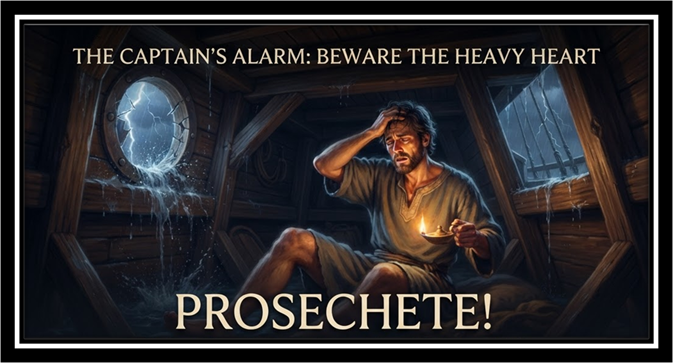
Take heed. That’s a command, not a suggestion. The Greek word is prosechete; it means pay attention, be on guard, keep watch. It’s an active, deliberate, continuous command. It’s the same word a sentry uses when he’s told to keep watch through the night. It’s not passive. It’s not “hope it goes well.” It’s “keep watch.”
Jesus is saying: the weight is coming. The mud is coming. The cares are coming. The excess is coming. The world is going to try to coat your feathers; that’s a guarantee. The only question is whether you’ll be watching. Will you be on guard? Will you notice the mud before it dries on, or will you wake up one day, try to fly, and find you can’t?
So, what does it look like, practically, to take heed to your own heart this week? Let me get real practical, because I’m a practical man and I believe the Word gets lived out in the everyday.
First, it means scheduling your watch. You take heed to your heart the way a soldier takes heed to his post. You set the time. You keep the appointment. You say, “This hour, at this time, I am going to be still before God, and nothing gets in the way.” And I’ll tell you the truth: if you don’t schedule it, it won’t happen. The world will eat your quiet time like a wolf eats a lamb.
Second, it means guarding your inputs. You take heed to what goes in. What you watch. What you listen to. What you read. What you dwell on. Because mud doesn’t come from nowhere; it splashes up from the ground you walk through. If you walk through the pigsty all day, you’re going to smell like pigs. If you feed your mind on the world’s table from morning till night, don’t be surprised when your spirit is malnourished and heavy.
Third, it means keeping short accounts. Don’t let mud dry on. Don’t let a week go by with unconfessed sin sitting on your conscience. Don’t let a grudge set in. Don’t let a care churn for months. Take heed means you deal with the weight while it’s still small, while it’s still wet, while it can still be washed off easily; before it dries and cakes and hardens.
So, let me ask you: can you name one specific guardrail you need to put up this week? Just one. One thing you know is weighing you down that you need to keep out or cut off. Maybe it’s the television. Maybe it’s the second helping. Maybe it’s the conversation you keep having. Maybe it’s the habit of checking the clock at 2 a.m. to worry. Name it. Don’t just say, “I should do better.” Name the guardrail. And then (here’s the key) tell somebody. Make yourself accountable. Because the eagle that takes heed to its feathers stays ready to fly.

Feather Cleaning in the Presence of God
Now, let’s talk about how the mud comes off. Because I know what some of you are thinking. “Terry, you’ve described me to a T. I’m heavy. I’m waterlogged. My wings are caked. What do I do?”
Here’s the beautiful thing: an eagle cleans its feathers. Did you know that? An eagle spends hours a day preening; grooming every feather, working out every bit of dirt and grime, making sure every barb is aligned so the air can flow over its wings. It’s not lazy about it. It’s diligent. It’s disciplined. And the believer’s version of feather cleaning is confession.
A believer confesses.
The honest, Spirit-led admission of the mud; that’s what restores the lift to our wings. First John tells us, “If we confess our sins, He is faithful and just to forgive us our sins, and to cleanse us from all unrighteousness.” Confess (homologeō) it means to say the same thing. To agree with God about the mud. To stop calling it “just a little TV” and start calling it what it is: a weight. To stop calling it “just stress” and start calling it what it is: worry, unbelief. To stop calling it “just letting off steam” and start calling it what it is: sin.
And here’s what happens in the secret place when we let the Lord gently wash the clay from our feathers. I want you to picture it. You come before Him, and you don’t have to perform. You don’t have to clean yourself up first; that’s the whole point, you can’t. You just come, heavy and muddy and ashamed, and you say, “Lord, here it is. Here’s the mud. I can’t get it off. Will You wash me?”
And He does. He is so gentle, family. He doesn’t scrape. He doesn’t rip the feathers out. He washes. He cleanses. He forgives. And one by one, the weights fall away. The guilt lifts. The fog clears. The heaviness breaks. And suddenly (oh, suddenly) you can feel the air again. You can feel the breeze under your wings. You can breathe.
That’s what repentance does. It doesn’t just forgive you; it restores your lift. It puts you back in the air.

The Holy Spirit as the Thermal Wind
And that brings me to the second thing. Because here’s the truth about eagles: an eagle cannot generate lift on its own. It can beat its wings all day, but if there’s no thermal, if there’s no wind, it can’t soar. It can flap, but it can’t rise. The eagle must catch the wind.
And so must you. So, I must.
The Holy Spirit is the wind beneath our wings. Jesus told Nicodemus, “The wind blows where it listeth, and thou hear the sound thereof, but canst not tell whence it cometh, and whither it goeth: so is every one that is born of the Spirit.” And the same Spirit who gives you new birth is the Spirit who lifts you into the heavenlies. He is the updraft. He is the thermal. He is the power that carries you up when your own strength gives out.
Have you experienced the Holy Spirit as the wind beneath your wings? I don’t mean some spooky, mystical thing. I mean the quiet strengthening. The unexplainable joy in the middle of a hard season. The peace that holds you steady when everything shakes. The surge of love for people you couldn’t love in your own strength. The insight that comes when you read the Word and suddenly a verse opens like a door. That’s the wind. That’s the Spirit.
And here’s the practical question: what does it mean to position your heart to catch His updraft? It means you get yourself into the place where the wind blows. The eagle doesn’t catch the thermal by staying on the ground. It gets up. It positions itself in the open sky where the rising air can reach it. And you position yourself for the Spirit by being in the Word, by being in prayer, by being in fellowship, by being in worship, by being obedient. You put yourself in the place where the Spirit moves, and then you wait. You open your wings. You trust.
You can’t make the wind blow. But you can stand in the open field. You can stop hiding in the cave of your own worries and your own entertainment and your own busyness. You can step out of the mud and spread your wings and wait on the Lord. And the promise is sure: “They that wait upon the Lord shall renew their strength.”

The Weight of Glory
Now I want to close with a beautiful mystery. It’s a paradox, and I want you to hold it in your heart.
That same Greek root; barus, heavy, that gives us barynthōsin, weighed down, is also used by the Apostle Paul in Second Corinthians, chapter four, verse seventeen. Listen to it: “For our light affliction, which is but for a moment, worketh for us a far more exceeding and eternal weight of glory.”
Weight of glory. Baros doxēs. The same word. The same root. One weight drags us down to the dirt. The other weight pulls us toward heaven.
So, here’s the question: how do you tell the difference between a burden that comes from the world and a weight that comes from the glory of God?
Let me tell you how I’ve learned to tell them apart. The world’s weight is heavy in the wrong way. It presses you down. It closes you in. It makes you small. It makes you anxious. It makes you tired in your soul. It steals your joy. It steals your peace. It makes you want to hide. The weight of the world feels like mud; wet, heavy, clinging, filthy.
The weight of glory is different. It’s heavy, but it lifts you. It’s a weight that pulls you upward; like a sail full of wind, like the gravity of heaven tugging at your heart. The weight of glory is the weight of God’s presence. It’s the weight of His love. It’s the weight of His purposes. And here’s the test: when you carry the weight of glory, you find that it’s strangely light. Jesus said, “My yoke is easy, and My burden is light.” The world’s burden gets heavier the longer you carry it. God’s burden gets lighter, because He carries it with you.
The weight of the world leaves you empty, exhausted, and afraid. The weight of glory fills you, strengthens you, and makes you brave. One is the mud on the eagle’s wings. The other is the very glory that the eagle is flying toward.
Oh, I want that weight. I want to be weighed down with glory, so full of Him that I can’t help but rise. But I’ve got to let go of the other weight first. You can’t carry both. The eagle can’t fly with mud on its feathers, even if it’s flying toward the sun.

The Day That Springs Like a Trap
And finally, listen again to Jesus’ warning: “…and so that day come upon you unawares.” In the next verse He says it will come “as a snare” on all them that dwell on the face of the whole earth.
What day is He speaking of? Oh, He’s speaking of that Day; the day of His return. The day when the Son of Man comes in the clouds with power and great glory. The day when every eye shall see Him. And I’ll tell you plainly, family: that day is coming. It may be soon. It may be sooner than we think. And Jesus says a heart that is overcharged, a heart that is waterlogged, a heart that is heavy with the world’s mud; that heart will be caught unawares. The trap will snap shut, and the eagle that should have been soaring will be found dragging in the dirt.
But hear me: it’s not just about that final day. It’s about today. It’s about tomorrow. Because a weighed-down heart makes you spiritually unprepared; not just for His return, but for what He wants to do today. The Lord has appointments for you this week that you will miss if you’re too heavy to rise. There’s a person He wants you to encourage. There’s a word He wants you to speak. There’s a prayer He wants you to pray. There’s a battle He wants you to fight; and to win. But you can’t fight from the ground. You can’t see from the ground. You can’t hear from the ground. The eagle fights from the air. The eagle sees from the air. The eagle hears from the air.
Don’t let the mud cost you today. Don’t let the weight rob you of the very thing God has for you this week. Take heed. Keep watch. Be ready. Because that day (and every day) is coming.

Closing
Now, before we go, I want to do something. I want you to close your eyes. Just for a minute. Don’t be embarrassed. Close your eyes.
Now, imagine the eagle. Imagine yourself.
Feel the weight of the mud on your feathers. Feel the cares; the ones you brought in with you tonight. Feel the noise; the constant noise that fills your house and your head. Feel the excess; the too much of everything. Feel the fear. Feel the worry churning in your chest. Feel how heavy it is. Feel how low you are. Feel the drag of it as you try to lift your wings and can’t. That’s real. That’s the barynthōsin heart. That’s what the world has done to you, and you know it’s true.
And now (by faith) feel the wind of the Spirit begin to stir. Feel the warmth of the Son. Feel that gentle breeze on your face, under your feathers. Feel the mud starting to dry. Feel it starting to crack. Feel it starting to fall away. Feather by feather. Weight by weight. And now feel; oh, feel the lift as you begin to rise. Feel your wings catch the air. Feel yourself leaving the ground. Feel the mud falling away beneath you. Feel yourself climbing, higher, into the open sky, into the light, into the very face of the Son.
That’s where you belong. That’s where He made you to live.
Now open your eyes.
Here’s the question I want to leave with you tonight, and I want you to take it home with you and answer it before you sleep: What needs to fall off your feathers today so that you can fly again?
Not what should fall off. Not what will fall off eventually. What needs to fall off today. Tonight. Right now.
Name it and Let it go. And then, this week, take heed to your heart. Set your watch. Guard your inputs. Keep short accounts. Position yourself in the wind. And wait on the Lord; for He has promised: they that wait upon the Lord shall renew their strength. They shall mount up with wings as eagles.
Let’s pray.
Father, we thank You. You did not make us to crawl. You made us to soar. And we confess tonight that we have let the mud of the world settle on our feathers. We’ve let excess dull us. We’ve let busyness intoxicate us. We’ve let the cares of this life churn in our hearts. Forgive us. Wash us. Cleanse us. And as we rise from this place, would You send Your Spirit like a wind beneath our wings? Lift us, Lord. Lift us into the high places with You. And keep us watchful, keep us heedful, keep us ready; until that day when we see You face to face. In the name of Jesus, who is our life, our lift, and our everything. Amen. Go in peace and fly. God bless you, family.